
Resistor color codes and capacitor markings: read the parts.
Open a 1958 radio and you're looking at maybe forty parts, but only eight or nine kinds of thing, most of them repeated. Learn the shapes and the markings, and the chassis stops being a thicket. Nothing here needs a meter or the set plugged in.
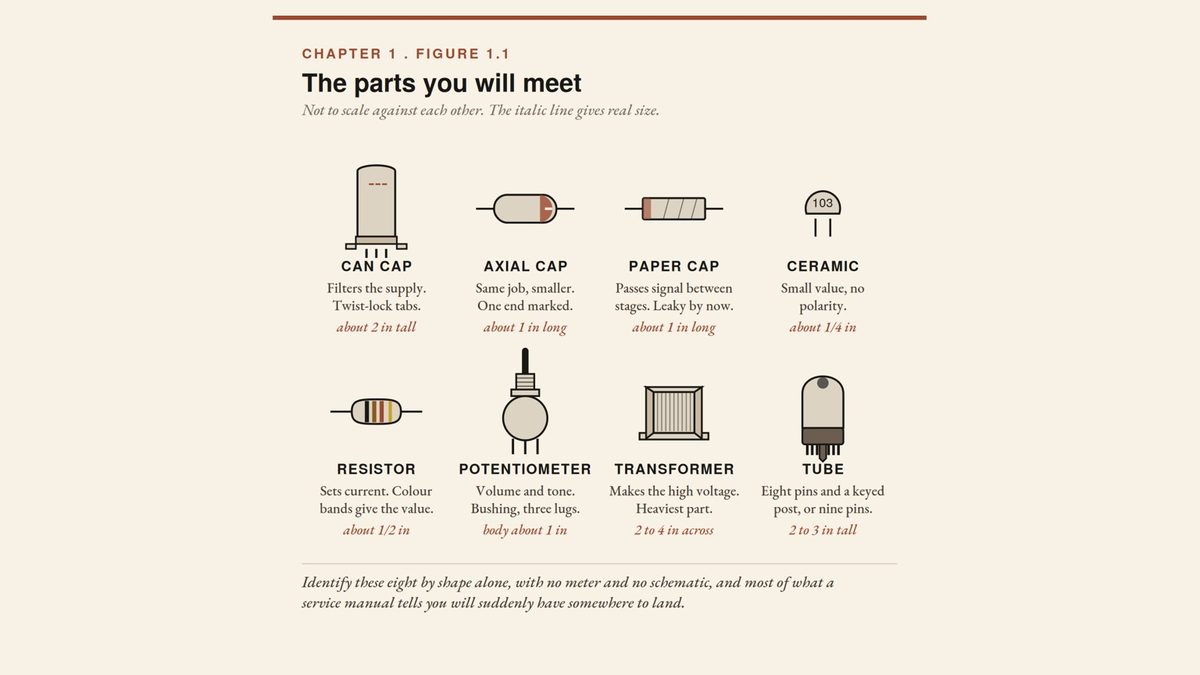
A four-band resistor reads from the end where the bands crowd the edge: first two bands are digits, the third is the number of zeros, the fourth is tolerance (gold 5%, silver 10%, none 20%). So brown, black, orange, gold is 1, 0, three zeros: 10,000 ohms at 5%. Small capacitors use a three-digit code in picofarads: 103 = 10,000 pF = 0.01 µF, and 104 = 0.1 µF.
Read a resistor or capacitor
Pick the colors or type the code, and you’ll get the value in plain numbers.
Hold it so the bands crowded toward one edge are on the left, and read from that end.
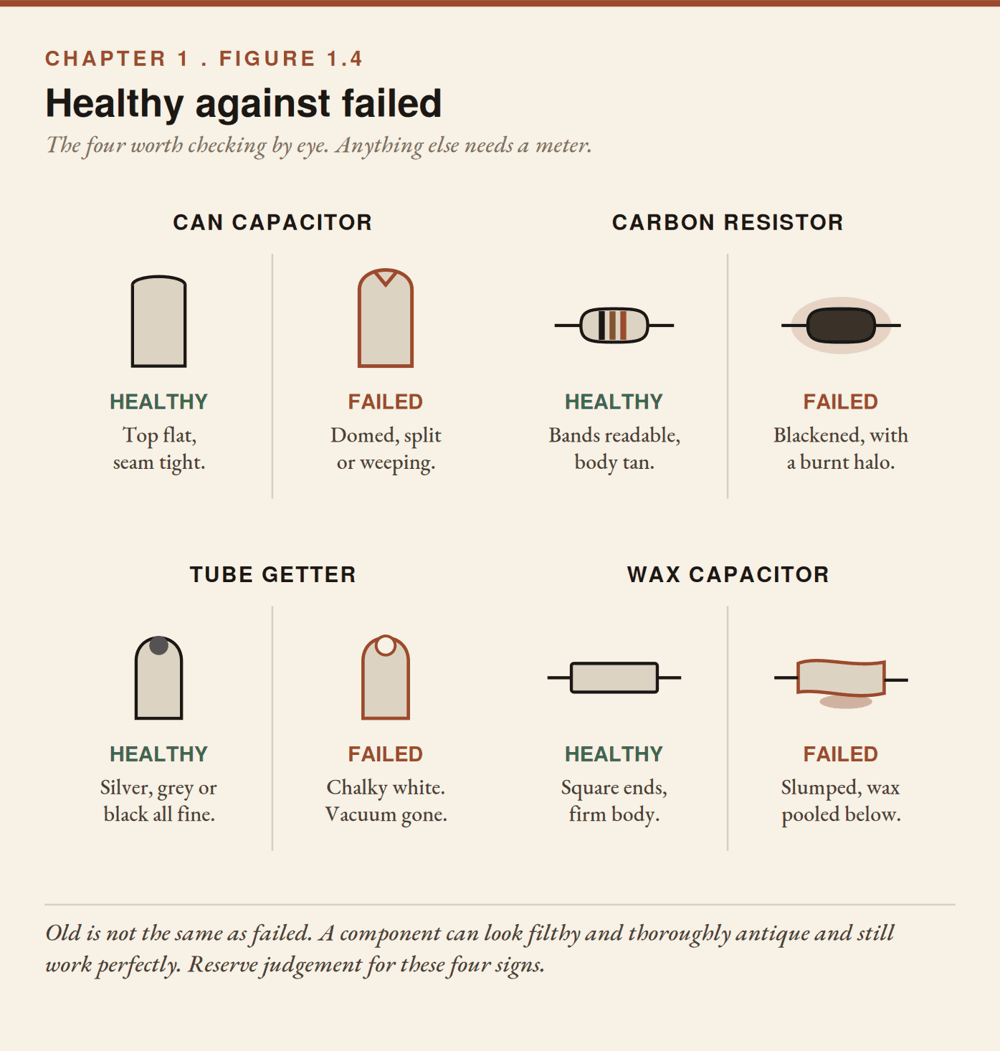
Bands scorched unreadable? That resistor has overheated, which is a diagnosis in itself.
Three digits, maybe with a letter after them, like 103 or 473J. Large capacitors just print the value, like “40 µF 450 V”.
The resistor color code
Read from the end where the bands are crowded toward the edge.
| Color | Digit | As multiplier |
|---|---|---|
| Black | 0 | ×1 |
| Brown | 1 | ×10 |
| Red | 2 | ×100 |
| Orange | 3 | ×1,000 |
| Yellow | 4 | ×10,000 |
| Green | 5 | ×100,000 |
| Blue | 6 | ×1,000,000 |
| Violet | 7 | ×10,000,000 |
| Gray | 8 | not used |
| White | 9 | not used |
| Gold | ×0.1 | |
| Silver | ×0.01 |
As a fourth band, gold means 5 percent tolerance and silver 10 percent. No fourth band at all means 20 percent, which tells you the part is old.
Worked example: brown, black, orange, gold reads 1, 0, then three zeros: 10,000 ohms, or 10 k, at 5 percent.
Two warnings for old parts. On sixty-year-old resistors the colors fade, and brown, red, and orange get hard to tell apart in poor light. Take the reading, then confirm with a meter before you order a replacement. And a resistor whose bands are scorched unreadable has overheated, which is a diagnosis in itself. A daylight-temperature bench lamp, around 5,000 K, helps here.
Two kinds of resistor
- Carbon composition: small, tan or brown, slightly bulged in the middle, with color bands. Vintage gear is full of them. They rarely fail open, but they drift high: 20 or 30 percent above the marked value is common after fifty years, and high values can be further out. In most positions it doesn't matter; around tube bias it matters a lot.
- Wirewound: larger, usually a rectangular ceramic body. They handle real power and are supposed to run hot, and some discoloration is normal. Black and crumbly, or scorching on the board beneath, means something downstream is drawing far too much current.
When you measure a resistor, do it with the power off and lift one leg. In-circuit readings are dragged low by everything in parallel, so a good 100 kΩ part can read 47 kΩ.
Reading capacitor markings
Large capacitors just say it: "40 µF 450 V". Small ones use a three-digit code in picofarads: the first two digits are the value, the third is how many zeros follow.
| Code | Picofarads | Microfarads | Where you tend to see it |
|---|---|---|---|
| 101 | 100 pF | 0.0001 µF | RF and oscillator circuits |
| 221 | 220 pF | 0.00022 µF | Tone shaping, treble bleed |
| 471 | 470 pF | 0.00047 µF | RF coupling |
| 102 | 1,000 pF | 0.001 µF | Bypass, tone stacks |
| 103 | 10,000 pF | 0.01 µF | Bypass, coupling |
| 223 | 22,000 pF | 0.022 µF | Signal coupling between stages |
| 473 | 47,000 pF | 0.047 µF | Signal coupling, tone stacks |
| 104 | 100,000 pF | 0.1 µF | Coupling, cathode bypass |
A letter after the digits is the tolerance, not part of the value: J is ±5%, K ±10%, M ±20%. Older parts may print the value directly: "MFD", and "MF" on 1940s parts, both mean microfarads.
Every capacitor gives you three things: the capacitance, the voltage rating, and the polarity if it has one. Get the polarity wrong on a part that has one and it will fail, sometimes loudly.
The capacitor types you'll meet
| Type | What it looks like | Status in old gear |
|---|---|---|
| Can electrolytic | Metal cylinder standing through the chassis; often several capacitors in one can, marked with a triangle, square, half-moon | The power supply filter. Most likely part to have failed, and it holds a lethal charge |
| Axial electrolytic | Fat cylinder with a wire at each end, rounded ends, negative end marked with a stripe or minus signs | Polarized. Fitted backwards it heats, swells, and vents |
| Paper or wax | Slimmer, square ends, wax-dipped or wrapped in printed cardboard, no polarity mark | Essentially all bad now; replace any in the signal path |
| Film | Modern, small, often a bright plastic case; polyester or polypropylene | The replacement for paper. Leave existing film parts alone |
| Ceramic disc | Small flat disc on two legs, like a tiny lollipop | Rarely the fault; when they fail they usually short |
Before you touch any can electrolytic, discharge it: see how to discharge a capacitor safely. Replacing the old ones is covered in recapping a vintage radio or amp.
What you need to read and check the parts
- Digital multimeterConfirm a color reading with a meter before you order a replacement: power off, one leg lifted.See options on Amazon →
- 5000K daylight bench lampFaded brown, red, and orange bands are easier to tell apart under daylight-temperature light, around 5,000 K.See options on Amazon →
- Film capacitorsFilm, polyester or polypropylene, is the replacement for the paper and wax capacitors in the signal path.See options on Amazon →
- Resistor assortmentFor replacements, once the meter has confirmed what the bands say.See options on Amazon →
These are Amazon links. If you buy through them I earn a small commission, at no extra cost to you.
Run the checks before you plug it in
Get the free Vintage Tube Amp Pre-Power Checklist: six checks to run before an old amp or radio goes anywhere near the wall.
One free PDF, delivered instantly. No spam, unsubscribe anytime.
DIY Vintage Audio Repair
Tube radios, amplifiers, and turntables: parts, safety, recapping, hum, signal path, controls, radio faults, and five full repair walkthroughs.
Read it on Amazon →How do you read a 4-band resistor?
Read from the end where the bands crowd the edge. The first two bands are digits, the third is the number of zeros, and the fourth is tolerance. Brown, black, orange, gold is 10,000 ohms at 5 percent.
What does 104 mean on a capacitor?
It's a three-digit code in picofarads: 10 followed by four zeros, which is 100,000 pF, or 0.1 microfarads. A letter after it, like J, K, or M, is the tolerance.