
Guitar amp tubes: look first, swap one at a time.
Tubes are the most visible part of the amp, so they get blamed first. Sometimes they deserve it. A few minutes of watching them warm up in a dim room tells you whether you need new glass or whether the fault is somewhere else.
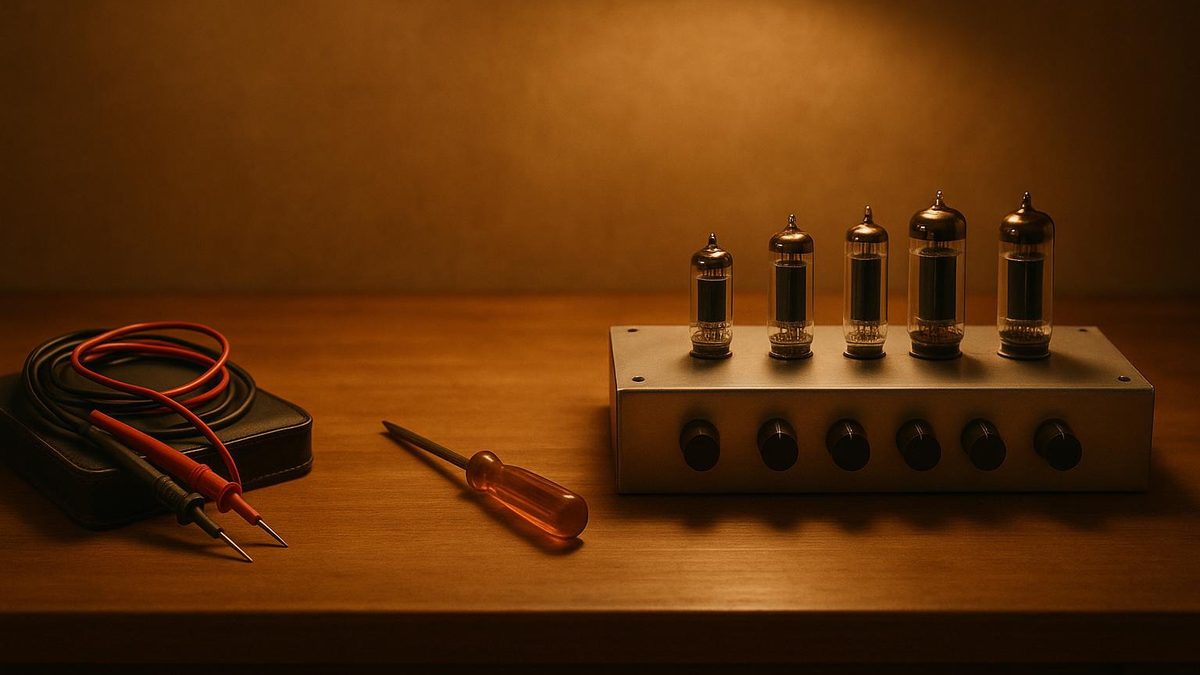
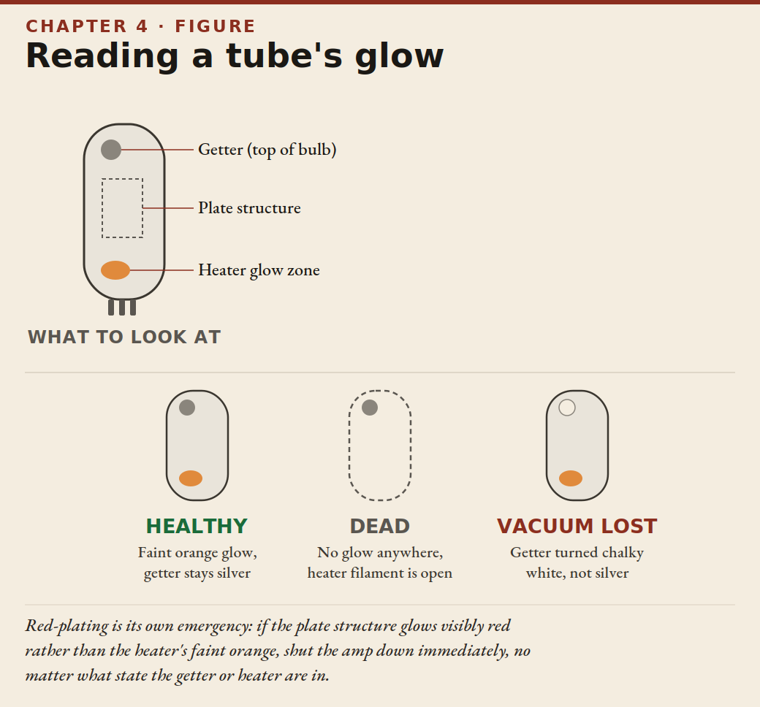
Watch the tubes warm up in a dim room. No orange heater glow means the tube is dead. A chalky white getter at the top means the vacuum is gone. Pink or purple glow in the plate means it's gassy and failing. A plate glowing red means it's running far too hot: shut down now. Confirm a bad preamp tube by swapping in a known-good one, one tube at a time.
Which tube is bad?
Three quick answers about what you see and hear, and you’ll know which tube to suspect and how to confirm it.
Look in a dim room right after power-on, with the standby switch on play. Anything abnormal usually shows in the first thirty seconds.
Preamp tubes are the small nine-pin ones, usually 12AX7 or 12AT7. Power tubes are the big ones that drive the speaker: 6L6, EL34, 6V6 or EL84.
Preamp tubes and power tubes
Preamp tubes are the small nine-pin tubes, usually 12AX7 or 12AT7. One of them, nearest the power tubes, is the phase inverter. Power tubes are the big ones that drive the speaker: 6L6, EL34, 6V6, or EL84 depending on the amp. Power tubes in pairs or quads are replaced as matched sets, never mixed with old tubes of unknown hours.
Signs a tube is really dead
None of these checks need tools, just your eyes. Do it in a dim room right after power-on; anything abnormal usually shows in the first thirty seconds.
- No heater glow at all, with the amp on and the standby switch in play. The heater is open and the tube is dead.
- A white getter. The silvery coating inside the top of the glass turns chalky white when air leaks in. The vacuum is gone.
- Pink or purple glow inside the plate structure. That's a gassy, failing tube, and it's probably dragging the bias with it.
- A red-hot plate, as opposed to the heater's faint orange. The tube is running far too hot. Shut the amp down immediately and see how to bias a tube amp.
A tube that's slightly brighter or dimmer than its neighbor is normal variation. You're watching for absence, or a color that doesn't belong.
What a failing tube sounds like
- A power tube that's going may compress and fart out on bass notes, or give a fizzy, quiet distortion that won't clean up when you roll back the guitar volume. A loud, low hum that doesn't change with the volume knob can mean it's shorted internally.
- A preamp tube that's dying sounds thin and weak, as if the tone knob were on zero, or crackles off and on. One that's dead can go completely silent.
Confirm it by substitution
Don't buy anything yet. Pull the suspect preamp tube and swap in a known-good one, for example from the phase inverter position (V3 or V4 in many Fender-style layouts). If the symptom follows the tube, replace it.
Swapping power tubes around is riskier, because a shorted power tube can blow a fuse or damage the output transformer. Use a tube tester or the bias measurement instead.
Never swap all the tubes at once. You'll never know which one failed, and a full set costs more than a shop's bench fee.
How to swap a tube without breaking it
- Photograph or sketch which tube goes where before you pull anything. Two 12AX7s in different positions can do completely different jobs.
- Remove any tube shield first. Push it down gently and give it a quarter-turn. A wrap of masking tape gives you grip on a stuck one.
- Grip the base, never the glass. Torquing the glass can break the seal, and a tube with a broken seal is dead, even if the crack is invisible.
- Power tubes: push down slightly and rock back and forth a few degrees until the tube releases from its socket. Preamp tubes pull straight out.
- To install, line the key or guide pin up with the socket, press gently straight down, and feel the pins seat. Forcing it bends a pin, and a bent pin is a repair job.
- Lock the shield back on before powering up. A loose shield can hum or rattle like a microphonic tube.
Crackle from a good tube in a dirty socket
Over years of heat cycling, socket contacts oxidize and lose their grip. If a tube crackles when you tap it, pull it, spray a little contact cleaner on the pins, and work it in and out of the socket a few times while the cleaner is wet. This fixes more crackling than new tubes do.
New power tubes and bias
If your amp has a bias adjustment pot (a fixed-bias amp), check the bias every time you replace power tubes. If it's cathode biased, there's nothing to adjust: swap the tubes and play. The schematic tells you which you have. The full method is in how to bias a tube amp.
Keep spares
A known-good 12AX7 or 12AT7 and one power tube of your amp's type give you a swap-for-test part when the amp goes silent. And remember the order: fuse and speaker cable first, before you touch a tube. The full diagnostic sequence is in guitar amp repair: where to start.
What you need to test and replace tubes
- 12AX7 preamp tubeA known-good spare to swap in and confirm a bad preamp tube.See options on Amazon →
- Matched power tube pairPower tubes are replaced as matched sets, never mixed with old tubes.See options on Amazon →
- Contact cleanerSpray the pins and work the tube in and out of a crackling socket.See options on Amazon →
- 12AT7 tubeThe other common preamp tube, worth keeping as a spare too.See options on Amazon →
- Tube testerChecks a suspect power tube without swapping it around the sockets.See options on Amazon →
- Masking tapeA wrap of it gives you grip on a stuck tube shield.See options on Amazon →
These are Amazon links. If you buy through them I earn a small commission, at no extra cost to you.
Keep the checklist on your bench
Get the free pre-power checklist: the no-sound gauntlet in the right order, plus the gig-day kit that fits in your gig bag.
One free PDF, delivered instantly. No spam, unsubscribe anytime.
DIY Guitar Amp Repair
Tube and solid-state amps: bench safety, no sound, crackle and hum, tubes and biasing, speakers, filter caps, jacks, and gig-day fixes.
Read it on Amazon →How do I know if my amp tube is bad?
Watch it warm up in a dim room. No heater glow, a chalky white getter, or pink and purple glow in the plate all mean a bad tube. Confirm a preamp tube by swapping in a known-good one.
Do I need to bias my amp after changing tubes?
If the amp has a bias adjustment pot, check the bias every time you replace power tubes. Cathode-biased amps have nothing to adjust, so you just swap the tubes.