
Guitar amp repair: start safe, then work in order.
Most amp failures are mechanical. A fuse blows, a jack tab snaps, a tube works loose, a filter cap dries out and hums. These aren't mysteries. If you can swap a pickup or solder a cable, you're already past the skill floor for fixing half of them.
Before you open anything, run the two-signal check: try the guitar in another amp, then a different cable. Then use the volume knob test to split the amp in half. If the amp is silent, check the fuse first, then the speaker connection, then the tube glow. You need three tools: a multimeter, a temperature-controlled soldering iron, and a screwdriver set.
Safety first. Tube amps hold 400 to 500 volts DC in the filter capacitors, even unplugged. That can kill you. Discharge the caps and confirm zero volts with your meter before your hands go in, and keep one hand behind your back whenever you probe a live chassis.
The safety habits that come first
Tube amps store lethal voltage in the filter capacitors long after the cord leaves the wall. Build these habits before you buy anything else.
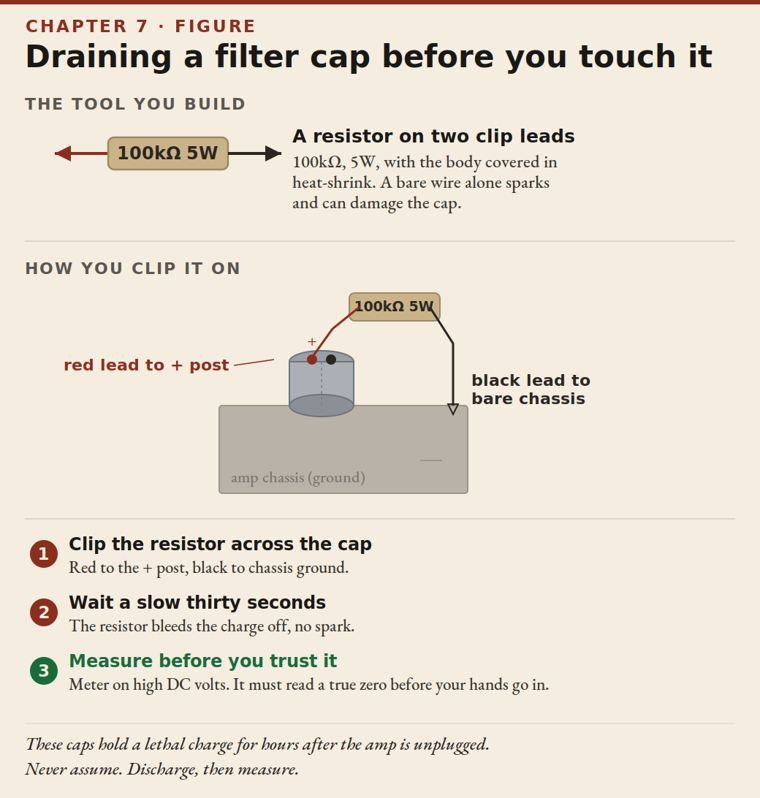
- A discharge tool. Solder a 100k-ohm, 5-watt resistor between two insulated alligator-clip leads and cover it in heat-shrink. Clip one end to the positive terminal of the first big filter cap and the other to chassis ground, wait 30 seconds, then measure. Only a steady zero means safe.
- The one-hand rule. When you probe a live chassis, keep your other hand in your pocket or behind your back. Current from fingertip to fingertip crosses your chest.
- No wrist strap inside a live tube amp. Clipped to chassis ground, it makes you a permanent ground path. It's for static-sensitive solid-state parts on the bench.
- A light bulb limiter. A 60 to 100 watt incandescent bulb wired in series with the amp's power cord. On the first power-up after a repair, it glows bright if there's a short and dims if the amp is healthy. If it stays bright, stop and find the short.
The three tools you actually need
A digital multimeter that reads DC up to 600 volts, AC up to 250, resistance to 20 megohms, and continuity with a beep. Auto-ranging helps. A $30 meter works.
A soldering station of 40 to 60 watts with a temperature knob, set around 650°F for leaded solder or 700°F for lead-free, with a chisel tip about 2 mm wide.
A screwdriver set from #0 to #3 Phillips and 3 to 6 mm flathead, plus insulated adjustment tools for bias pots. A metal screwdriver near a live circuit can short two points. A scope, a signal tracer, and a tube tester can wait until a repair actually needs them.
Step 1: prove it's the amp
Plug your guitar into a different amp you know works. If the problem follows the guitar, it's the guitar. If not, try your amp again with a different cable; cables fail at the strain relief inside the plug.
Then test the input directly. Plug a short patch cable into the input, turn the volume up a little, and touch the tip of the free end. A loud buzz means the preamp, power amp, and speaker are all passing signal. If you get the buzz but the guitar still won't come through, the fault is between the input jack and the first preamp stage.
Step 2: split the amp in half
With no guitar plugged in, turn the volume from zero to full. If the hum or crackle changes with the knob, the problem sits before the volume control, in the input or first preamp stage. If it stays the same at every setting, it's after the volume control, in the power amp or power supply.
Step 3: no sound at all
- Check the fuse. It's the most common cause of a silent amp. Many amps have a mains fuse and a separate high-voltage fuse; a blown high-voltage fuse leaves the pilot light on and the tubes glowing with no sound. Replace it with the exact same rating. If the new one blows at once, stop: there's a short. See why a guitar amp fuse keeps blowing.
- Check the speaker connection. Running a tube amp with no speaker load can destroy the output transformer. Use a known-good cable and cabinet, and on a combo, check the spade connectors haven't vibrated loose.
- Watch the tubes warm up in a dim room. Every tube should show a faint orange heater glow near the base. No glow means a dead tube or a bad socket connection. See how to tell if an amp tube is bad.
- Check B+ voltage only if you know where to probe safely from the schematic. If you don't, skip this step.
- The chopstick test. With the volume around three, gently press each tube and each socket connection with a wooden chopstick. A spot that crackles or cuts the sound in and out has a cold solder joint or loose pin.
If all five pass and the amp is still silent, the problem is likely the output transformer or the wiring to the speaker. That's tech territory.
Crackling and cutouts
Intermittent noise is almost always mechanical. Wiggle the cable in the input jack first; if the crackle follows, the jack's ground tab is cracked or the contact is corroded. Next, the tube sockets: pull a tube, spray a little contact cleaner on its pins, and work it in and out of the socket a few times. That fixes more crackling than new tubes do. Crackle that ignores tapping often comes from an aging preamp plate resistor, usually 100k or 220k, which a short burst of freeze spray on each one will find.
Hum
All tube amps hum a little. If you can hear it across the room with the volume on two, something's wrong. First, unplug the guitar. If the hum vanishes, it's the guitar or the room, and single-coil pickups hum by design near lights and transformers.
Touch the strings. The hum should drop. If touching the strings makes the hum louder, stop playing the rig. That's a grounding fault, and an amp with a bad safety ground can put mains voltage on your strings.
To name the hum, play the B at the seventh fret of the low E string. If the hum sits at that pitch, it's 120 Hz, which almost always means dried-out filter caps, and it won't change with the volume knob. An octave below is 60 Hz, which points at grounding, heater wiring, or a leaky preamp tube.
Hum that only happens at gigs is usually a ground loop. Put everything on the same power strip and circuit, and use the ground lift on a DI box. Never defeat the safety ground on your amp's power cord to quiet it.
Don't start by buying tubes
Most silent amps have one bad fuse, not six bad tubes. A crackling amp usually has a dirty jack or a failing resistor, and a loud hum usually means filter caps. Diagnose first, then swap one known-good tube at a time if the tests point there.
When to step away
If the amp is under warranty, don't open it. If the board is cracked, the traces are burnt, or a budget combo has a shorted output transformer that costs more than the amp is worth, hand it to a tech or replace it. And an amp that smells like burnt sugar and blows its fuse instantly every time has a hard short that can take new tubes with it if you guess wrong.
After any repair, play at low volume for five minutes, then at stage volume, and listen for anything that wasn't there before.
What you need to start repairing amps
- Digital multimeterDC to 600 volts, resistance and a continuity beep: every check here starts with it.See options on Amazon →
- Soldering stationA 40 to 60 watt station with a temperature knob, for cold joints and jack tabs.See options on Amazon →
- Screwdriver setPhillips #0 to #3 and 3 to 6 mm flathead, to get the chassis out.See options on Amazon →
- 100k ohm 5 watt resistorsHalf of your discharge tool for the filter caps. Measure after: only a steady zero means safe.See options on Amazon →
- Insulated alligator clip leadsThe other half of the discharge tool: clip one end to the cap, the other to chassis.See options on Amazon →
- Contact cleanerClean tube pins and jacks. It fixes more crackling than new tubes do.See options on Amazon →
These are Amazon links. If you buy through them I earn a small commission, at no extra cost to you.
Keep the checklist on your bench
Get the free pre-power checklist: the no-sound gauntlet in the right order, plus the gig-day kit that fits in your gig bag.
One free PDF, delivered instantly. No spam, unsubscribe anytime.
DIY Guitar Amp Repair
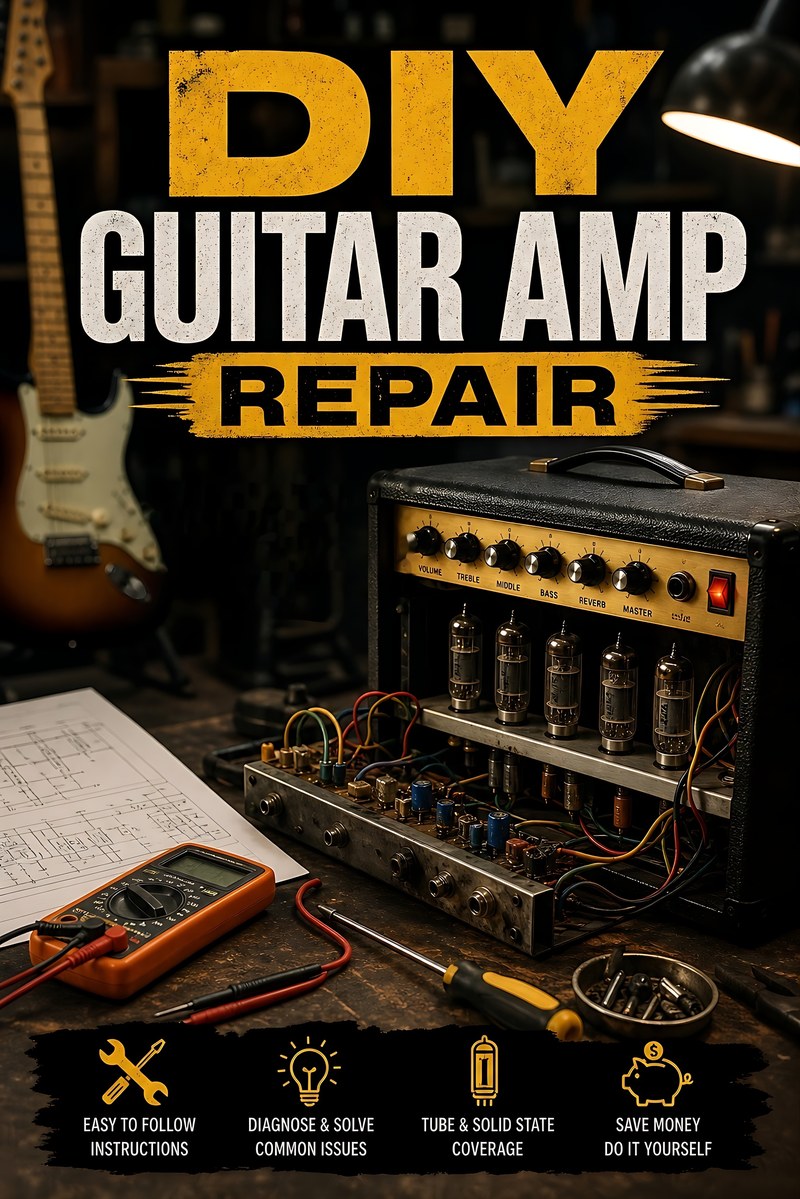
Tube and solid-state amps: bench safety, no sound, crackle and hum, tubes and biasing, speakers, filter caps, jacks, and gig-day fixes.
Read it on Amazon →What is the most common guitar amp problem?
A blown fuse is the most common cause of a silent amp. Most amp failures are mechanical: a fuse, a broken jack tab, a loose tube, or dried-out filter caps.
Is it safe to repair a tube amp yourself?
Only with the right habits. Tube amps store 400 to 500 volts in the filter caps even when unplugged. Discharge them, confirm zero volts with a meter, and probe a live chassis with one hand only.