
How to bias a tube amp: measure, calculate, then turn slowly.
Bias sets how much current your power tubes draw at idle. Too cold and the amp sounds thin and raspy. Too hot and it sounds great for about twenty minutes before the plates glow red. There's no single magic number, but there is a simple formula.
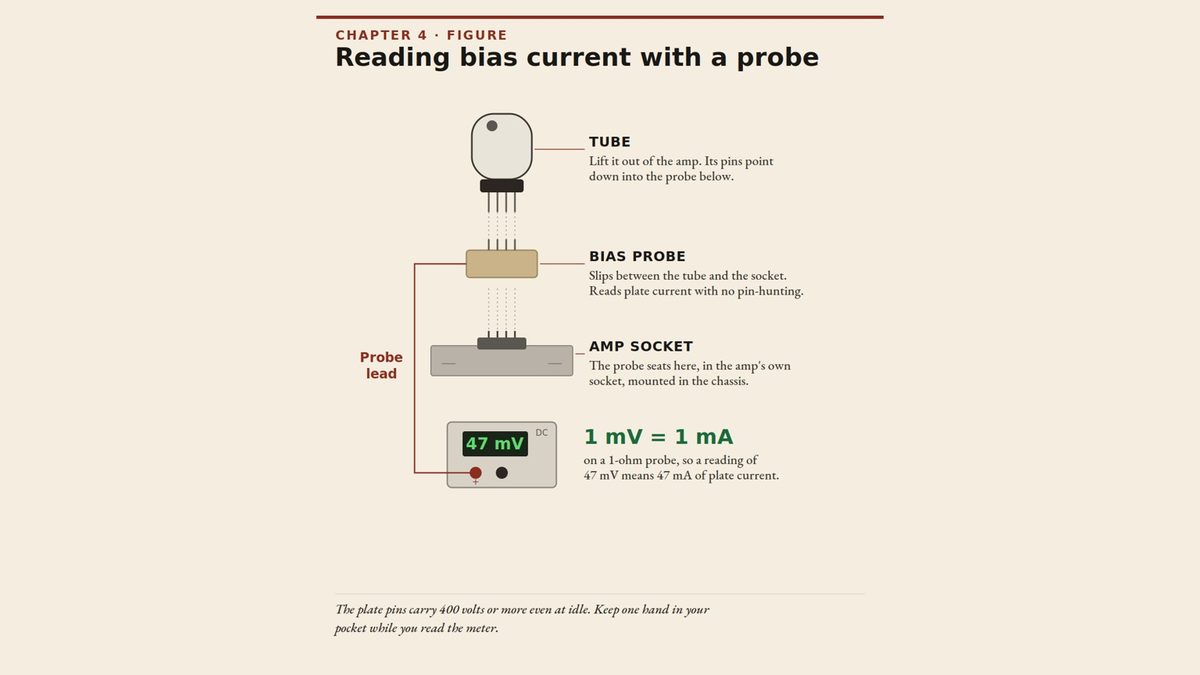
Only amps with a bias adjustment pot (fixed bias) need adjusting. Measure the plate voltage, then set idle current to 0.7 × the tube's maximum plate watts ÷ plate volts. For a 6L6GC at 450 volts, that's about 47 mA. Read it with a bias probe (on a 1-ohm probe, 1 mV = 1 mA), turn the pot slowly, and recheck after ten minutes of playing.
Work out your bias target
Pick your power tube, enter the plate voltage you measured, and you’ll get the idle current to set, with the math shown.
Fixed bias: a bias adjustment pot inside the chassis. Check bias whenever you change power tubes.
Max plate watts: 30 W. The table below covers 400 to 500 V.
Measure it at the plate (pin 3 on most octal power tubes) with the amp running. The target is 70 percent of the tube’s maximum dissipation, the figure the guide uses.
Optional. Leave it blank if you haven’t measured the current yet.
Safety first. Tube amps hold 400 to 500 volts DC in the filter capacitors, even unplugged. That can kill you. Discharge the caps and confirm zero volts with your meter before your hands go in, and keep one hand behind your back whenever you probe a live chassis.
What bias does
Bias is a negative DC voltage on the power tube's control grid. The more negative it is, the less current flows and the cooler the tube runs. Think of idle speed on an engine.
- Too cold: efficient, but thin and brittle, with crossover distortion, a raspy breakup at low volume.
- Too hot: fat and rich for a while, then the plates glow cherry red and the tube cooks itself. Hot bias also wears out output transformers.
Find out which kind of bias you have
- Cathode bias: a resistor from cathode to ground sets the current automatically. Common in smaller combos. Nothing to adjust; just swap tubes and play.
- Fixed bias: a separate negative supply feeds the grids through a bias adjustment pot inside the chassis. Check bias whenever you change power tubes.
- Cathode bias with a selectable resistor: a factory switch picks between two cathode resistors. The Vox AC30CC's SW5 selects 50 ohms (HOT) or 82 ohms (WARM). If an AC30CC is cooking tubes, moving it to WARM is the right first step, with no soldering and no high voltage. Don't confuse it with the amp's other switches for smoothing capacitance and output impedance.
The schematic tells you which one you have.
The tools
The safest method on a fixed-bias amp is a bias probe that sits between the tube and its socket and breaks out the plate current on its own lead. It costs about the same as one set of burned-out tubes. Some amps have built-in bias test points, which need no probe. A third method measures the voltage across a precise cathode resistor, often 1 ohm. Measure that resistor's real resistance first, because resistors drift with heat and age.
Set your meter to DC millivolts. On a probe with a 1-ohm resistor, one millivolt equals one milliamp. Never set the meter to read amps unless the probe is built for it: a meter on the wrong range becomes a short circuit and blows a fuse instantly.
Find the number that matters
Anyone who says "set all 6L6s to 35 milliamps" is guessing. The right current depends on your amp's actual plate voltage. Measure it at the plate (pin 3 on most octal power tubes) with the amp running, then:
Target idle current = 0.7 × maximum plate watts ÷ plate volts
That puts the tube at 70 percent of its maximum dissipation: cool enough to last, warm enough to sound good. Here is the math already done, with dissipation figures from manufacturer datasheets:
| Tube | Max plate watts | Plate volts | Target idle |
|---|---|---|---|
| 6L6GC | 30 W | 400 / 450 / 500 V | 52 / 47 / 42 mA |
| EL34 | 25 W | 400 / 450 / 500 V | 44 / 39 / 35 mA |
| EL84 | 12 W | 300 / 320 / 350 V | 28 / 26 / 24 mA |
| 6V6GT | 12 W | 350 / 400 / 415 V | 24 / 21 / 20 mA |
| KT88 | 35 W | 450 / 500 / 560 V | 54 / 49 / 44 mA |
Treat the table as a starting point. If you measure 430 volts on a 6L6GC, do the arithmetic rather than splitting the difference between rows.
Setting it
- Confirm the amp has a bias pot and that you've read the safety rules above.
- Fit the probe (or connect to the test points) following the probe maker's instructions.
- Measure the plate voltage with the amp running and work out your target.
- Turn the bias pot slowly. A quarter-turn can move the current 10 milliamps or more. Stop when the reading settles near your target.
- Recheck after ten minutes of playing. Plate voltage shifts as the amp warms up.
Measuring a cathode-biased amp
Measure the DC voltage across the cathode resistor, then the resistor's actual resistance with the amp off and discharged, and divide. If the resistor is shared by several output tubes, divide by the number of tubes. Cathode current also includes screen current, roughly ten to fifteen percent of plate current, so this method overstates plate dissipation slightly. That error is in the safe direction.
Some famous amps run past the datasheet
The Vox AC30CC runs its EL84s around 322.5 volts against a datasheet maximum of 300. The Fender Deluxe Reverb AB763 runs its 6V6GTs at about 415 volts against a 315 volt class A maximum. That's by design. Don't bias them unusually cold to "protect" the tubes; you'll just get crossover distortion. Set bias by the method, from the voltage you measure, and expect these amps to go through tubes faster.
Red flags: stop and diagnose
- New tubes blow the fuse when you switch from standby to play. A shorted tube, or a bias supply that has lost its negative voltage. Check the bias voltage at the power tube's grid pin; most fixed-bias amps show roughly -35 to -55 volts. Zero or positive means the bias supply has failed.
- Red-plating. Shut down. If the bias isn't simply set too high, the coupling capacitor feeding the grid may be leaky. Replace that cap before you bias anything; it costs a dollar and will red-plate a new set of tubes.
- The pot won't go low enough (current stays high at minimum): a fault in the bias supply, such as a drifted resistor or failing bias filter cap. It won't go high enough: worn-out tubes or a bias supply putting out too much negative voltage. Fix the circuit before fitting new tubes.
- Current reads double the math with the pot in the normal range: suspect the output transformer or filter choke. That's beyond a tube-and-bias job.
- An amp converted from cathode to fixed bias keeps eating tubes. Check that the grid resistors were lowered to the datasheet's fixed-bias limit.
Spotting a bad tube before you bias is covered in guitar amp tubes: when and how to replace.
What you need to bias a tube amp
- Bias probeSits between the tube and its socket: the safest way to read plate current.See options on Amazon →
- Digital multimeterSet to DC millivolts: on a 1-ohm probe, one millivolt equals one milliamp.See options on Amazon →
- Matched 6L6GC pairNew power tubes go in as a matched set, then you check the bias.See options on Amazon →
- Matched EL34 pairNew power tubes go in as a matched set, then you check the bias.See options on Amazon →
- Matched EL84 pairNew power tubes go in as a matched set, then you check the bias.See options on Amazon →
- Matched 6V6GT pairNew power tubes go in as a matched set, then you check the bias.See options on Amazon →
These are Amazon links. If you buy through them I earn a small commission, at no extra cost to you.
Keep the checklist on your bench
Get the free pre-power checklist: the no-sound gauntlet in the right order, plus the gig-day kit that fits in your gig bag.
One free PDF, delivered instantly. No spam, unsubscribe anytime.
DIY Guitar Amp Repair
Tube and solid-state amps: bench safety, no sound, crackle and hum, tubes and biasing, speakers, filter caps, jacks, and gig-day fixes.
Read it on Amazon →What should I bias my tubes to?
Measure your plate voltage, then use 0.7 times the tube's maximum plate watts divided by plate volts. A 6L6GC at 450 volts comes out around 47 mA; an EL34 at 450 volts, around 39 mA.
Do all tube amps need biasing?
No. Cathode-biased amps set their own idle current, so there is nothing to adjust. Fixed-bias amps with a bias pot need checking whenever you change power tubes.