
How to make a SCOBY, and keep a spare.
You do not need anyone to hand you a SCOBY. One bottle of the right store-bought kombucha holds everything needed to grow your own. It takes two to four weeks of patience and costs a few dollars.
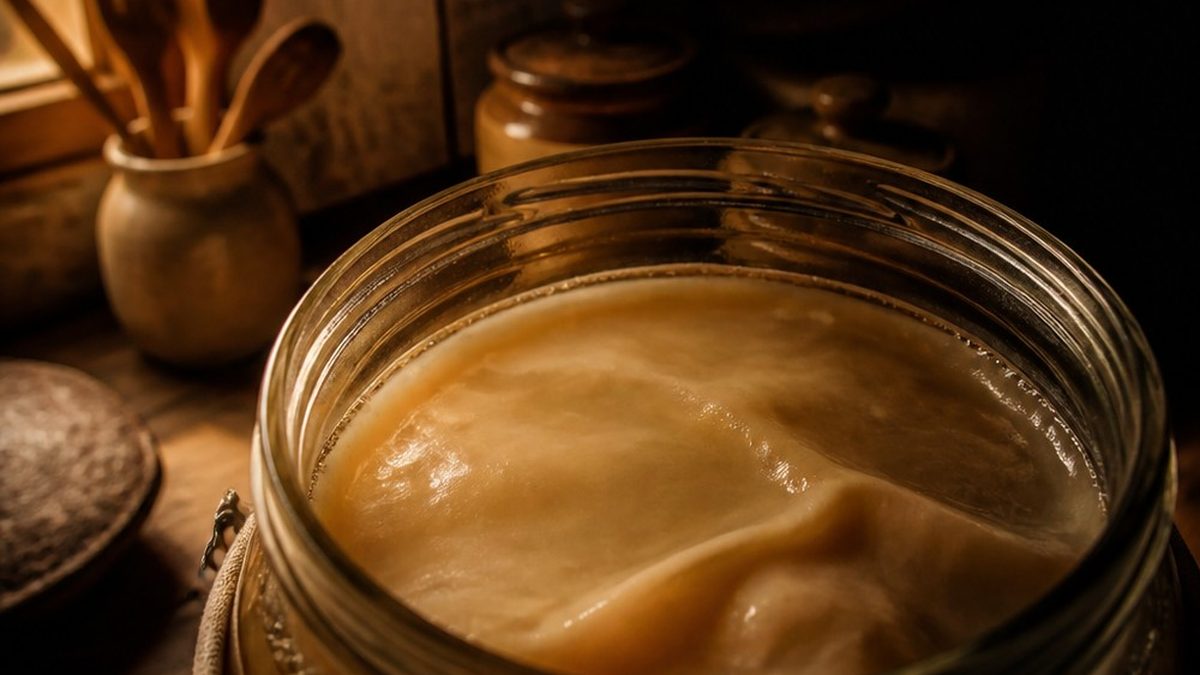
Pour a whole bottle of raw, unpasteurized, unflavored kombucha, sediment and all, into a wide glass jar with about 2 cups of cooled sweet tea. Cover with cloth and keep it at 75 to 85°F without touching it. When the new skin is about a quarter inch thick, usually in two to four weeks, it is ready.
Choose the right bottle
Everything hinges on the bottle. You want raw, unpasteurized kombucha that still has live cultures, and the label has to say raw or unpasteurized, because pasteurized bottles have had the culture killed. Choose a plain, unflavored variety, not one sweetened or flavored with juice. Look for visible sediment and stringy bits settled at the bottom: that cloudy material is the living culture you are about to grow.
Grow it, step by step
- Make a small, strong sweet tea. Boil about 2 cups of water, dissolve 2 to 3 tablespoons of white sugar, and steep 2 black or green tea bags until it is good and strong. Let it cool all the way to room temperature, because hot tea will kill the culture.
- Combine it with the whole bottle. Pour the entire bottle of raw kombucha, sediment and stringy dregs included, into a wide-mouth glass jar, then add the cooled sweet tea. A wide jar grows a skin faster, because more surface meets the air.
- Cover it and set it warm. Use a breathable cloth and a band, and put the jar somewhere around 75 to 85°F, out of direct sun, where it will not get bumped.
- Leave it completely alone. Do not stir it, move it, or peek under the surface. Growing a culture from scratch is much slower than a normal batch.
What you will see, week by week
For the first several days, expect little or nothing, perhaps a cloudy or faintly oily film across the surface. That is normal. Over the following weeks, a pale, thin skin spreads across the top and slowly thickens, with brown strands beginning to hang below it. The new SCOBY is ready once it is about a quarter inch thick, solid enough to lift without falling apart. In a warm kitchen that might take two weeks; in a cool one, a month or more.
The mold rule still applies. A thin, flat, slightly oily film is part of the process and is not mold. Mold is fuzzy, dry, and raised into islands, often white, green, blue, or black. If you see real fuzz, pour it all out, clean the jar, and start over with a fresh bottle.
Then brew your first batch
Use the new SCOBY together with the liquid it grew in as your starter, and brew a full gallon from the base recipe. Do not worry if your first homegrown SCOBY looks thin, patchy, or a little ugly. The first batch may also run slower than later ones. The culture gets stronger with every batch.
If it is not working
If weeks go by with no skin forming at all, the likeliest problem is the bottle, since not every store kombucha has a vigorous live culture. Try a different brand, ideally one with visible sediment and strands at the bottom. Move the jar somewhere warmer if your room runs cool. And give it more time: the most common mistake is expecting it to move as fast as a normal batch.
Keep spares in a SCOBY hotel
Every batch grows a new layer, so you will soon have extras. A SCOBY hotel is a dedicated glass jar where spare SCOBYs live in mature, unflavored kombucha. It gives you backup culture if a batch ever molds, plus a ready source of strong starter.
- Set it up: put the spare SCOBYs in a clean glass jar, cover them by at least an inch of mature, unflavored kombucha, and cap it with a breathable cloth and band.
- Keep it at room temperature, out of direct sun. Do not refrigerate it; cold stalls the culture and lets the acidity drift at the surface.
- Feed it now and then: when a SCOBY starts to peek above the surface, or the liquid smells harsh and thin instead of cleanly tart, pour off some of the oldest liquid for starter and top it up with newly finished kombucha.
- Never add plain water, sweet tea, or fruit. The hotel is storage, not a place to flavor.
Going away for more than a week? Park your SCOBY in the hotel, where it keeps more or less indefinitely as long as it stays submerged and the liquid stays tart.
What you need to grow a SCOBY
- Wide-mouth glass jarA wide jar grows a skin faster, because more surface meets the air.See options on Amazon →
- Cloth covers and bandsA breathable cover keeps the jar open to air and closed to fruit flies.See options on Amazon →
- Black tea bagsTwo bags make the small, strong sweet tea the new culture feeds on.See options on Amazon →
- White sugarTwo to three tablespoons of plain white sugar for the starter tea.See options on Amazon →
- Jar for a SCOBY hotelSpare SCOBYs live here, covered by at least an inch of mature, unflavored kombucha.See options on Amazon →
These are Amazon links. If you buy through them I earn a small commission, at no extra cost to you.
Keep the checklist by the jar
Get the free SCOBY Rescue Checklist: whether what you are seeing is normal or a real problem, and how to fix the real ones.
One free PDF, delivered instantly. No spam, unsubscribe anytime.

Kombucha Brewing for Beginners
The full guide: the base recipe, tasting and timing, the second ferment, pH testing if you want it, troubleshooting, and keeping it going.
Read it on Amazon →How long does it take to grow a SCOBY?
Usually two to four weeks at 75 to 85 degrees F. In a cool kitchen it can take a month or more.
Should I keep a SCOBY in the fridge?
No. Keep spare SCOBYs in a SCOBY hotel at room temperature, covered by at least an inch of mature unflavored kombucha.