
Mohs hardness at the bench: what it tells you, and what it doesn’t.
Mohs numbers get thrown around a lot, but what matters at the bench is how fast a stone answers your file and paper, how easily its edges chip, and when to change grits. Hardness is part of that story. Toughness is the other part.
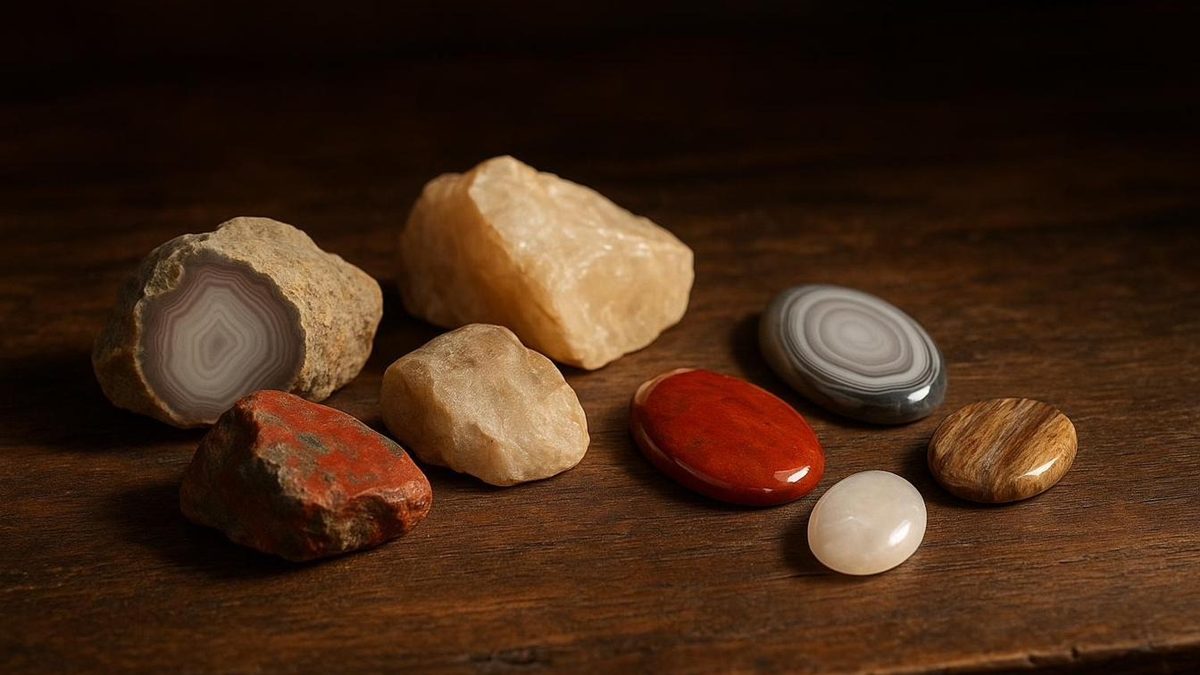
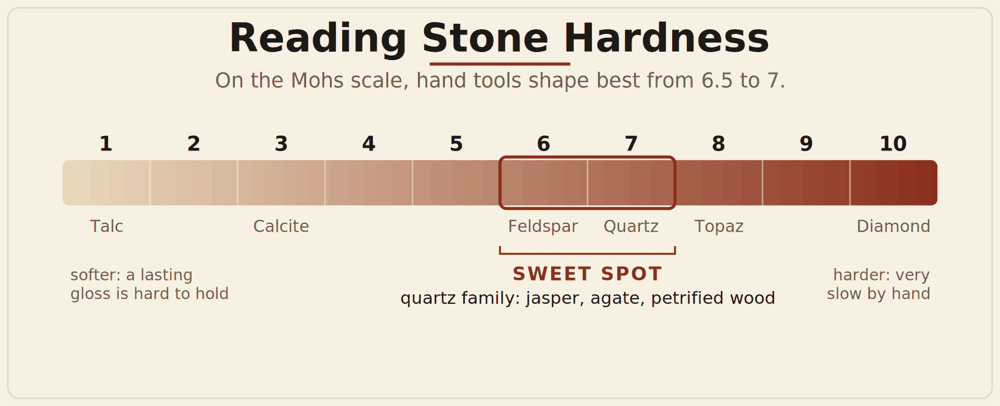
The Mohs scale ranks scratch resistance from 1 (talc) to 10 (diamond). For shaping by hand, the sweet spot is about 6.5 to 7, the quartz family: jasper, chert, agate, aventurine, quartzite, and silicified petrified wood. They're hard enough to wear well and still shape by hand. A steel file sits around 6 to 6.5: if it skates and sings, you're near 7. If it bites and throws powder, you're down around 5 to 6.
What grit do I start with?
Pick your stone, or give its Mohs number, and you’ll get its hardness, how it behaves by hand, and where to start on the grit ladder.
From 3 (calcite) to 10 (diamond). Halves like 6.5 are fine.
Test on a corner you’ll grind away anyway, wet, with glasses on.
Look at a break, heft it, tap the far side gently with a wooden dowel, and wet it and rake a light across it. Tap any that apply.
What the scale measures
Mohs hardness is scratch resistance: what scratches what. On the scale, talc sits at 1, calcite at 3, feldspar at 6, quartz at 7, topaz at 8, and diamond at 10. Softer stones shape fast but a lasting gloss is hard to hold. Harder ones are very slow by hand.
Hardness is not toughness
Toughness is chip resistance: whether a thin edge survives. A stone can have one without the other, and confusing them is why a stone surprises you.
- Jasper is both hard and tough, which is exactly why it's the beginner sweet spot.
- Jade is nowhere near the hardest stone, but it's tough and fibrous, so it resists cutting and feels gummy rather than chippy. It takes several times the shaping time of serpentine.
- Calcite is soft, so it shapes fast, but it's fragile and undercuts the moment a coarse grit touches it.
- Obsidian is glassy and brittle: its edges shell off when a file slips, and it shows every missed scratch.
How common stones behave by hand
| Stone | Mohs | By hand | Start at |
|---|---|---|---|
| Jasper, chert | 6.5 to 7 | Dense and tough; grinds predictably, the stone to learn on | 80 or 120 |
| Agate, chalcedony | 6.5 to 7 | A touch slower than jasper, very forgiving; watch bands for hairlines | 120 |
| Aventurine, quartzite | 6.5 to 7 | Uniform texture that sands evenly, if you finish every grit before moving up | 120 |
| Petrified wood (silicified) | 6.5 to 7 | Works like jasper when fully mineralized | 80 or 120 |
| Serpentine | 3 to 5 | Soft and fast; satin to bright polish, not an agate mirror | 120 |
| Calcite, marble | 3 | Shapes fastest, scratches and undercuts; reaches a soft satin by hand | 220 |
With hand tools, the quartz family takes roughly two to three times as long to shape as serpentine at the same size and dome. A thumb-sized cab at a medium dome is the better part of an hour on quartz and well under that on serpentine.
Test a stone at home
Test on a corner you'll grind away anyway, wet, with glasses on.
- File test. A clean steel file sits around Mohs 6 to 6.5. If it skates and sings without raising dust, you're near 7, agate or jasper. If it bites, grooves, and throws powder, you're around 5 to 6.
- Coin and nail. A copper coin is near 3, a steel nail near 5.5. Drag each once using only its own weight. A colored streak that wipes away is metal transfer; a groove that stays is a scratch. If the coin scratches, suspect calcite. If the nail won't bite, you're likely in jasper or agate.
- Glass. The rim of an old glass jar is about 5.5. The quartz family scratches the glass, not the other way around.
- Grit tempo. Pencil a line a millimeter in from an edge and sand toward it on wet 220. Jasper and agate make you work for it; serpentine gets there in a fraction of the time. Fast removal is a warning, not a gift: it flags soft, scratch-prone material.
Read toughness and flaws too
- Look at a break. Smooth, glassy curves mean crisp but brittle edges, so plan a wider bevel. Grainy or sugary breaks mean uneven grain that undercuts, so use a stiffer backing and smaller grit steps.
- Heft it. Dense material around 2.5 to 2.7 grams per milliliter, like quartzite and jasper, takes longer. Light, open stone under about 2.2 is porous, so keep coarse grit off it.
- Tap it. Tap the far side gently with a wooden dowel. A clear, bell-like ring usually means a solid piece; a dull thud points to hidden cracks.
- Wet it and rake a light across it. Straight dark lines that wick water are usually healed fractures. Cloudy patches that stay dark suggest porosity.
Use it to pick your starting grit
Take a few test strokes with a coarse file on a wet edge. If it bites cleanly and the shape moves within a minute, start at 120. If it skates or chatters, drop to 80 so the abrasive does the digging, not your shoulder. Fragile calcite or fluorite starts at 220 and goes slowly. From there it's the same ladder for everything: see how to polish stones by hand.
Before you cut serpentine: some serpentine and soapstone carry asbestos fibers, which are hazardous to breathe. Buy from a seller who confirms the stone is asbestos-free, keep it wet at every step, wear a P100 respirator, and never dry-work it. Treat any unlabeled green stone as suspect.
Ready to cut your first one? Start with how to cut a cabochon by hand.
What you need to test a stone
- Flat steel fileA clean steel file sits around Mohs 6 to 6.5, so it is the quickest test on the bench.See options on Amazon →
- Wet/dry sandpaperSand toward a pencil line on wet 220 to read the grit tempo, then start the ladder.See options on Amazon →
- Safety glassesTest on a corner you’ll grind away anyway, wet, with glasses on.See options on Amazon →
- P100 respiratorFor serpentine and soapstone, on top of keeping the stone wet and never dry-working it.See options on Amazon →
- Small LED flashlightWet the stone and rake a light across it to spot healed fractures and porosity.See options on Amazon →
- Wooden dowelsTap the far side gently: a clear ring usually means solid, a dull thud means cracks.See options on Amazon →
These are Amazon links. If you buy through them I earn a small commission, at no extra cost to you.
Keep the checklist on your bench
Get the free Cabochon Starter Checklist: the beginner stones, the hand tools, the grit order, and the safety steps on one page.
One free PDF, delivered instantly. No spam, unsubscribe anytime.
The Hand-Tool Lapidary Handbook
Shape, polish, and finish gemstones by hand: forgiving stones, budget tools, the grit ladder, three first cabochons, carving, polish, and fixes.
Read it on Amazon →What Mohs hardness is best for beginners?
About 6.5 to 7, the quartz family: jasper, chert, agate, aventurine, quartzite, and silicified petrified wood. They shape predictably by hand and take a strong polish.
How can I test a stone's hardness at home?
Use a steel file, around Mohs 6 to 6.5. If it skates without raising dust, the stone is near 7. A copper coin, near 3, and a steel nail, near 5.5, narrow it down further.