
Liquid on top of your starter? That is hooch.
Hooch is the thin, gray or brown liquid that pools on a hungry starter. It can smell sharp or boozy. It's a signal, not a failure: your starter ate all its food and needs a fresh meal.
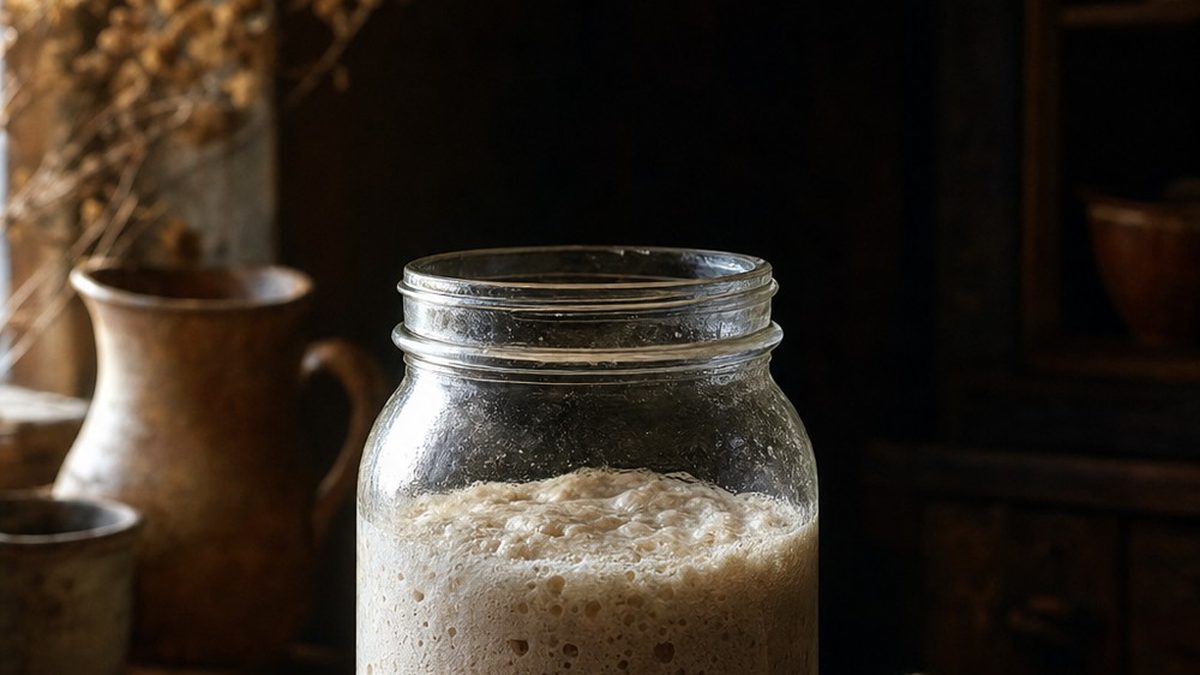
Pour the hooch off, keep 20 g of starter, and feed 1:2:2 (or 1:3:3 in a warm room or if it smells sharp). Mix it slightly thick and feed every 12 hours at about 75 to 78°F until hooch stops appearing between feeds, usually within 1 to 3 feeds.
Why hooch forms
Hooch is alcohol and organic acids the culture makes once it runs out of food. As acidity climbs, the yeast slow down and the rise stalls. Warm rooms speed up how fast the starter eats, and long gaps between feeds nearly always lead to hooch. Very wet starters separate more easily and show it sooner.
Gray or tan liquid is normal. Pink, orange, or fuzzy growth is not: that's contamination, so discard the starter and start fresh.
Pour it off or stir it in?
You can stir hooch back in once a starter is healthy. During a rescue, pour it off. Removing it lowers the alcohol and acid before you feed, and the aroma usually improves within a feed or two. Tip the jar over the sink, or spoon it off without dragging out paste.
The fix, step by step
- Pour off the hooch and scrape down the sides so dry smears don't fall back in.
- Keep only 20 g of starter as your seed and discard the rest. A small seed dilutes the built-up acid fast. Don't rinse the starter under water; you'd wash away the strongest cells.
- Feed bigger. In a cool room (below about 72°F), feed 1:2:2: 20 g starter, 40 g water, 40 g flour. In a warm room, or if it smells sharp or like solvent, feed 1:3:3 (60 g water, 60 g flour) for the first two feeds.
- Mix it slightly thick. Aim for a soft, scoopable paste that mounds on a spoon for a moment, then settles. If it's runny, add flour a teaspoon at a time.
- Feed closer together. Park the jar at 75 to 78°F and feed every 12 hours until hooch stops showing up between feeds. Then switch back to your normal ratio, often 1:2:2.
If the starter is very flat or smells strongly of solvent, do two quick 1:3:3 refreshes 6 to 8 hours apart on day one, then return to every 12 hours. Don't stack more than two quick feeds in a row, or you'll dilute it too far.
What success looks like
Within 1 to 3 feeds, hooch should disappear, or only show up after a long wait. The starter smells cleaner, rises more, and fills with even bubbles. The texture turns airy instead of pasty.
Keeping hooch away
- Feed before the starter collapses fully. If you regularly see hooch within 10 to 12 hours, feed a bigger ratio or move the jar somewhere cooler.
- In a warm kitchen, 1:3:3 helps avoid acid buildup. In a cooler room, 1:2:2 is fine.
- If you keep it in the fridge, give it a double feed before chilling and another after you take it out.
- Still getting hooch after 3 days? Try a one-time 1:5:5 feed, then go back to 1:2:2, and swap 25% of the flour for whole wheat for two feeds.
What you need to fix hooch
- Digital kitchen scale (grams)Keep only 20 g as your seed, then feed 40 g or 60 g each of water and flour.See options on Amazon →
- Mini silicone spatulaScrape down the sides after pouring off the hooch so dry smears don't fall back in.See options on Amazon →
- Whole wheat flourStill getting hooch after 3 days? Swap 25% of the flour for whole wheat for two feeds.See options on Amazon →
- Measuring spoonsIf the mix is runny, add flour a teaspoon at a time until it mounds on a spoon.See options on Amazon →
These are Amazon links. If you buy through them I earn a small commission, at no extra cost to you.
Keep the fix next to the jar
Get the free one-page Starter Rescue Checklist: seven symptoms, the fix for each, and the feeding ratios in one place.
One free PDF, delivered instantly. No spam, unsubscribe anytime.
Sourdough Starter Rescue
The full guide: a 7-day plan to revive a dead or failing starter, plus a fix for every symptom, from hooch and mold to a starter that won't rise.
Read it on Amazon →Is hooch on sourdough starter bad?
No. Gray or brown hooch means the starter is hungry. Pour it off and feed. Pink, orange or fuzzy growth is different: discard the starter.
Should I pour off hooch or stir it in?
During a rescue, pour it off to lower acidity. Once the starter is healthy you can stir it back in.