
Common weld defects: read the bead, then fix the cause.
Every defect leaves a clue in the bead. Learn a handful of patterns and you can diagnose most problems at the bench, decide whether the weld needs to come out, and stop the same mistake from showing up on the next part.
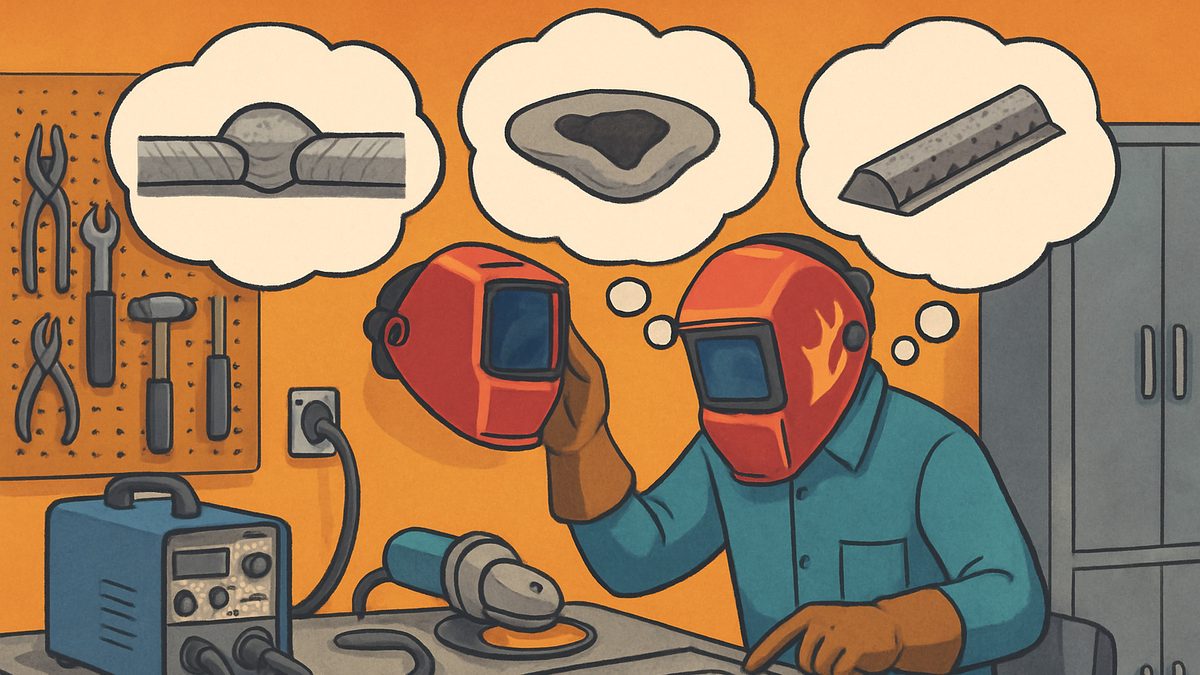
A sound weld is smooth and evenly rippled, with a clean toe and a consistent crown. The five common defects are porosity (gas or contamination), lack of fusion (low heat or fast travel), undercut (too much current or a long arc), burn-through (too much heat on thin metal), and cracking (hydrogen, cooling stress, or joint design). Fix the cause, then grind out and reweld anything structural.
What’s wrong with my weld?
Three quick answers and you’ll get the likely defect, the fix, and whether to grind it out.
Compare it with a sound bead: smooth and evenly rippled, with a clean toe and a consistent crown.
No special tools needed. Tap any that apply, or leave them all off.
Tap any that are true. Leave them all off for a non-structural part.
Start with what a good bead looks like
A smooth, evenly rippled bead with a clean toe and a consistent crown usually means correct heat, travel speed, and technique. That's your baseline. Compare every bead against it.
The five common defects
| Defect | What you see | Usual cause | Fix |
|---|---|---|---|
| Porosity | Pinholes, pits, or blisters | Oil, rust, moisture, or poor gas coverage | Check gas and leaks, clean the joint, dry the filler |
| Lack of fusion | A shiny sliver or cold, sharp line at the toe | Too little heat, too-fast travel, wrong angle | Slow down, raise amps or voltage, clean the joint edges |
| Undercut | A groove along the toe | Too much current or too long an arc | Drop amps, shorten the arc |
| Burn-through | Holes and ragged edges on thin metal | Too much heat in one spot | Lower amps, stitch weld, use a backing bar |
| Cracking | Cracks during cooling or appearing later | Hydrogen, cooling stress, joint design | Low-hydrogen electrodes, preheat where needed, less restraint |
Porosity
Trapped gas from surface contamination, damp filler, or weak shielding. Check the regulator, hoses, nozzle, and flow, then clean the metal. Full steps are in how to fix weld porosity.
Lack of fusion
The weld metal sits on the base metal without bonding to it. It's almost always heat input or technique: the arc isn't hot enough, or you're moving past the joint too fast for the metal to wet the edges. Slow your travel, or raise amperage (voltage on MIG). On stick, try a slightly larger electrode or more amperage. Clean off scale, paint, and oil, keep root gaps consistent, and consider a root pass or backer for penetration.
Undercut
A groove along the toe that weakens the edge. Shorten the arc or drop the amperage. More in weld undercut causes and fixes.
Burn-through
Most common on thin sheet and light tubing, and once metal is gone you often have to patch or scrap the part, so prevention matters most. Lower the amperage, shorten the arc, and travel slightly faster. Stitch weld in short segments and tack often. Backing bars, ceramic backing, or copper chill blocks soak up heat on thin sections.
Cracking
Hot cracks form as the weld solidifies. Cold cracks show up later from hydrogen and residual stress. Use low-hydrogen electrodes such as E7018 and store them dry, in a heated oven if required. Preheat where needed to slow cooling. Reduce restraint with good fit-up and avoid sharp geometry that concentrates stress.
Checks you can do without special tools
- Tap test. Tap the bead with a small hammer. A bright ring usually means good fusion. A dull thud can flag inclusions, poor fusion, or shallow penetration.
- Feel. Run a gloved finger along the toes for sharp undercut or rough slag pockets.
- Bend or nick a coupon welded with the same settings to check ductility and root fusion.
- Section a test weld. Cut and grind it to see bead shape and penetration.
- Magnify. A loupe or phone close-up shows fine porosity. Photograph the settings next to the result.
Grind it out, or accept it?
Ask three questions. Does it affect fit or assembly? Will it carry structural load or cyclic stress? Will it create a corrosion or sealing problem? If any answer is yes, repair it. Anything in a primary load path, a joint root, an area exposed to fatigue, or a part that must seal fuel or water gets repaired.
Minor undercut, slight overlap, or shallow spatter on a non-structural piece that will be painted or coated can usually be ground and blended.
How to repair it properly
- Remove all of it. Grind or gouge until you reach clean, bright metal and a groove shape the new weld can penetrate.
- Clean and dry the part before you tack.
- Re-tack in a balanced pattern, such as opposite corners, to control distortion.
- Reweld for the defect: more heat and slower travel for lack of fusion, a shorter arc or lower amps for undercut, dry filler and good shielding for porosity.
- Inspect around the repair for new cracks or heat damage, and fix the root cause so it doesn't return.
Then make it a habit: a quick visual, hand-feel, hammer tap, and photo after each critical bead, and one variable changed at a time when something's off.
What you need to check and repair a weld
- Jeweler's loupeFine porosity shows up under a loupe or in a close-up phone photo.See options on Amazon →
- Small hammerTap the bead. A bright ring usually means good fusion, and a dull thud is a flag.See options on Amazon →
- Angle grinderGrind a defect out until you reach clean, bright metal before you reweld.See options on Amazon →
- Copper backing barSoaks up heat on thin sections to help prevent burn-through.See options on Amazon →
- E7018 electrodesLow-hydrogen rods that help prevent cracking. Store them dry.See options on Amazon →
- Welding rod ovenKeeps low-hydrogen electrodes dry when the type requires a heated oven.See options on Amazon →
These are Amazon links. If you buy through them I earn a small commission, at no extra cost to you.
Keep the fault finder by the welder
Get the free Bead Fault Finder: match what you see to the likely cause and the fix for MIG, TIG, and stick.
One free PDF, delivered instantly. No spam, unsubscribe anytime.

Modern Welding for Makers
The whole small shop: power, ventilation, and layout, a chapter each on MIG, TIG, and stick, starting settings by thickness, and beginner projects.
Read it on Amazon →What are the most common weld defects?
Porosity, lack of fusion, undercut, burn-through, and cracking. Each one has a typical look and a typical cause, so reading the bead points you to the fix.
How can I check a weld without special tools?
Look for an even, rippled bead with clean toes, tap it with a small hammer for a bright ring, feel the toes for undercut, and bend or section a test coupon welded with the same settings.